Why community theatre needs position descriptions more than the professionals do
By Roscoe · 17 July 2026 · 8 min read
There's a comforting myth in community theatre that position descriptions are a professional indulgence — something the big companies with paid staff and union contracts need, but that a group of volunteers who all know each other can happily do without. We're friends, the thinking goes. We'll sort it out as we go.
It's exactly backwards. A professional production is the one place you can get away with not writing the roles down, because the industry already has. A professional stage manager arrives with a contract, a rate, and forty years of accumulated convention telling everyone precisely what a stage manager does and doesn't do. The definition exists whether or not that particular theatre prints it. The role is enforced by money, by unions, by a career's worth of expectation.
A volunteer company has none of that. No contract, no rate, no union rulebook, no shared professional training that means the word "producer" lands the same way in every head in the room. All you have is what you've agreed among yourselves — and if you haven't agreed it out loud, you haven't agreed it at all. The absence of professional scaffolding is the reason to build your own, not permission to skip it.
What "we'll sort it out as we go" actually costs
When nobody's role is defined, work doesn't disappear. It flows downhill to whoever feels most responsible — usually the same two or three people, usually the ones least able to say no. The undefined production ends up with a director doing the budget, a musical director chasing venue keys, and one heroic volunteer quietly holding six jobs nobody ever named.
That arrangement has three predictable failure modes:
- The gaps. Everyone assumes someone else is handling the thing. Nobody is. It surfaces the week before opening, when it's expensive to fix and nobody has spare capacity.
- The overlaps. Two people both think they own the poster, the programme, the front-of-house roster. They make different decisions. The clash lands in a group chat at eleven at night.
- The one who breaks. Because the load is invisible and unshared, the person carrying it can't get sick, can't take a weekend, and can't leave without the production losing a chunk of its working memory. Then they burn out, and you discover how much they were holding only when they stop.
None of these are talent problems or attitude problems. They're definition problems. And definition problems have a cheap fix that most companies never reach for: writing it down before the season starts, not after it breaks.
What a good position description actually contains
A position description in community theatre doesn't need to be a formal document with letterhead. It needs to answer four questions clearly enough that two different people would read them the same way:
- What is this role for? One sentence. If you can't say the purpose in a line, the role is doing too many jobs and should be split.
- What does it own? The specific, nameable things this person is accountable for. Not "helps with marketing" — owns the social media calendar and the press release.
- What does it not own? This is the line everyone skips, and it's the most valuable one. A boundary is a gift: it tells the person they're allowed to stop, and it tells everyone else where to take the thing that isn't this person's job.
- Who does it work with, and who does it answer to? So the reporting line is clear and nobody's waiting on a decision from a person who was never going to make it.
A standard position description answers the first, second and fourth of these in its summary, its duties, and its reporting lines. The third — the boundary — is the one no template prints for you; state it explicitly wherever roles tend to collide.
How everyone fits together
The hardest field to fill in is usually "reports to." Community theatre rarely has a tidy hierarchy, and two capable people each assuming they're in charge of the same thing is how tech week turns into a standoff. So before you write the descriptions, sketch the shape.
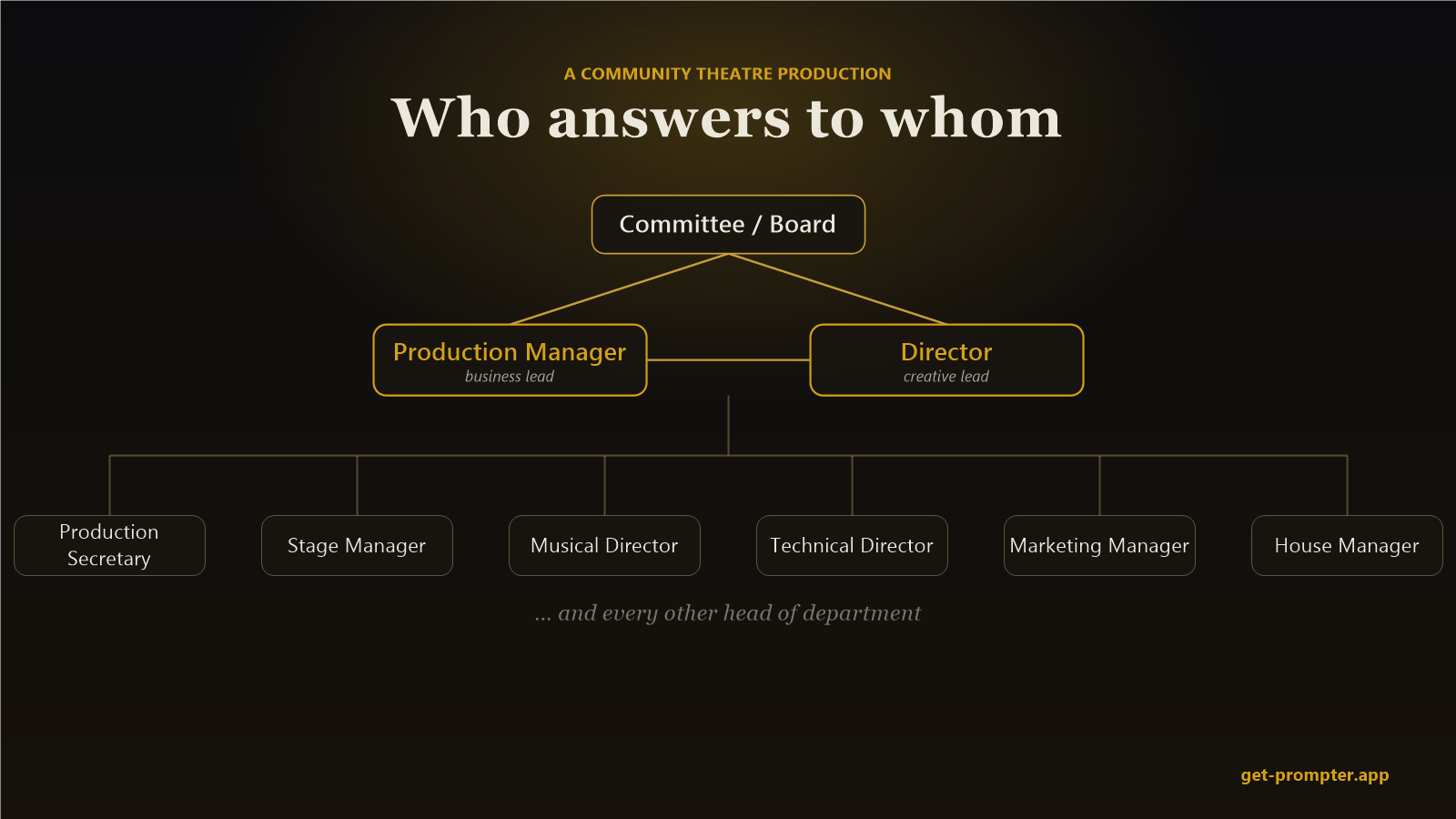
Most community productions have two leaders, not one. The Production Manager owns the business and the machinery — budget, rights, schedule, the whole project happening. The Director owns the art. They lead side by side, and everyone else answers up to one or both of them.
Underneath sit the heads of department, each running their own patch:
- Committee / Board — governs the company; appoints the production's leads
- Production Manager (business lead) & Director (creative lead)
- Production Secretary — coordination and the production's memory
- Stage Manager — the rehearsal room and calling the show
- Musical Director — the music (musicals) · Choreographer — movement and dance
- Technical Director — the build and technical coordination
- Lighting · Sound · Costume · Makeup Designers — the design departments
- Props Master — sourcing and running the props
- Marketing Manager — the audience
- House Manager — front of house, and the usher, box-office and concessions team on the night
- Production Manager (business lead) & Director (creative lead)
Draw yours differently if your company works differently — the point isn't this exact tree, it's that everyone can see the same one. A "reports to" line is only meaningful if the whole team agrees where it points.
The pack: a position description for every head of department
Rather than leave you to build these from a blank page, we've written one for every head-of-department role in a community production — each following a standard format: summary, duties, required and preferred experience, time commitment, and working conditions. Each role is a separate editable Word file, bundled in one download, with a blank template to copy for anything we haven't covered.
⬇ Download the position descriptions pack (Word files, .zip) — free, no email required.
Fourteen roles, one file each:
- Production Manager — overall accountability for the project
- Director — the artistic vision and the rehearsal room
- Musical Director — teaching and leading the music (musicals)
- Choreographer — movement and dance
- Production Secretary — the schedule and the production's memory
- Stage Manager — running rehearsals and calling the show
- Technical Director — the build and technical coordination
- Lighting · Sound · Costume · Makeup Designers — the four design departments
- Props Master — sourcing and running the props
- Marketing Manager — filling the seats
- House Manager — front of house and audience safety
Not every show needs every role — a play won't want a Musical Director or Choreographer — and the blank template is there for anything we haven't covered.
One in full
Here's exactly what's inside, using the role that most often goes undefined:
Position Description: Production Secretary
- Department / Program: Production
- Reports To: Production Manager (works day-to-day as the Director's right hand)
- Supervises: Production Assistant
- Position Type: Volunteer, per-production
- Term: Pre-production through post-production wrap
Position summary — The production's single source of truth for who is called, when, where, and whether they know about it. Owns the machinery the show runs on, not the content of what's decided.
Essential duties
- Build and maintain the master schedule and rehearsal calls.
- Get calls out and confirm attendance; track availability and conflicts.
- Organise and minute production meetings.
- Keep the shared documents, contact list, and callboard current.
- Coordinate communication across every department.
…plus required and preferred experience, time commitment, and working conditions — the same shape for all fifteen. (We wrote a whole post on this particular role.)
The one habit that makes all of this stick
Writing the roles down once, at the start, does most of the work. But the habit that keeps a company healthy year after year is smaller than that: when a role changes hands, hand over the description with it.
The reason companies re-learn the same painful lessons every production is that the knowledge lives in people, and people rotate. A defined role is a role that can survive a handover — the incoming volunteer inherits not just a title but an actual description of what they've taken on, and the outgoing one leaves without taking the production's memory with them.
That's the whole case for position descriptions in a nutshell. Not bureaucracy for its own sake — continuity. The professionals get their continuity from an industry. You have to build yours on purpose, and it starts with a sentence per role, agreed out loud, before the season begins.
Prompter is built around exactly this idea — roles, responsibilities and access defined per production, so the machinery survives the people. But you don't need our software to start. Download the pack, or just open a blank document this week and write one line for each role: what it's for. You'll be further ahead than most companies ever get.
Prompter is free for grassroots community theatre.
Run your whole production from one place — and only pay if you choose to.
See what's included